A Good Life
As 2025 ends, this is an ode to the millennial generation. To the modern troubles we carry, the burnout that lingers in the background, and the way we so often forget how far we’ve come and how well we’ve done. It is worth a celebration. This one is personal—straight from the heart—for my friends, whom I love deeply. You all deserve this reminder.
COMING OF AGEDIGITAL AGEMODERN SOCIETYMILLENNIALS
12/30/202510 min read
As I listen to Schubert playing in my damp bathroom, sunlight stealthily passing through a crack in the small window, the air smelling like roses, vanilla scented candles, the mirror is fogged up and waiting to be doodled in with a damp and dainty finger. “I’m a terrible writer when I am not left alone.” I think to myself. It was my first shower in weeks that wasn’t quick. I took a day off. For some reason, my mind wandered off to 2018, lockdown. I was living in a quaint village up in the mountains. The usual comforts of life ceased to exist. A new kind of comfort and luxuries that I never knew of, came to life. The kind you don’t pay for, only notice: the stillness of watching the eccentric outline of a mountain at 5 am, the truest pink of a wild bougainvillea sprawling by the window, almost as if the colours radiated more with genuineness just because it was so unbelievably quiet, that one little birdie repeating the same tune every evening, the feel of earth under bare feet, no care in the world, except how to make it to that cafe through the muddy trails, the worst that can happen is I get lost in the woods, under the tapestry of darkness painted by moonlight and fir trees, “There is no sweeter music on earth than that which the wind makes in the fir trees at evening.”
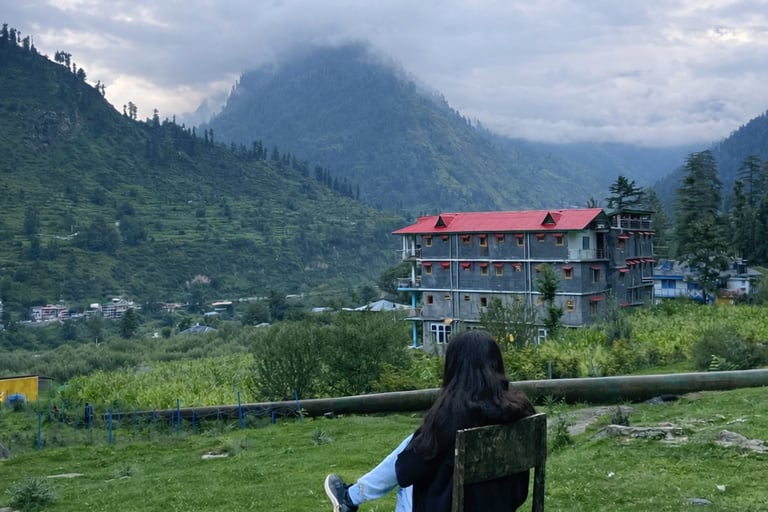
Photo by the author
Staring Into The Void
A moment of zoning out in a conference room. Watering the same plant twice because my brain is wrapped in fog. An unwashed cup setting off an avalanche of irritation.
When my mother was a little girl, she swam in the pond behind her house. There was a forest nearby where she collected flowers and coconuts. She taught ten-year-olds at school. She ate food that grew at the nearby farm. When the village had power cuts, she and her sisters would sit on the porch with only a handfan and an oil lamp between them. They talked. They waited for the breeze to graze their skin. They had nowhere else to be. That sounds like a good life. What a quiet kind of beauty to live in a world where no one spoke of vacations and weekends, because life itself wasn’t something to escape from. We don’t live like that anymore. We reward exhaustion and wear burnout like a badge.
My mother sat under the soft glow of an oil lamp in the 1970s and I have inherited the pale glow of my laptop, eyes shielded by my blue-light eye glasses basking under the atmospheric buzz of an AC that doesn’t ever hit that right cooling temperature. I spend some otherwise valuable time of my evenings being on mute in meetings, a silent square in a grid of faces. I don't have the luxury of walking barefoot in the forest, but I do have access to a manicured garden—if I can make time. But at the end of the day, I am chasing steps on a treadmill and switching between grocery apps to stock the fridge for the week.
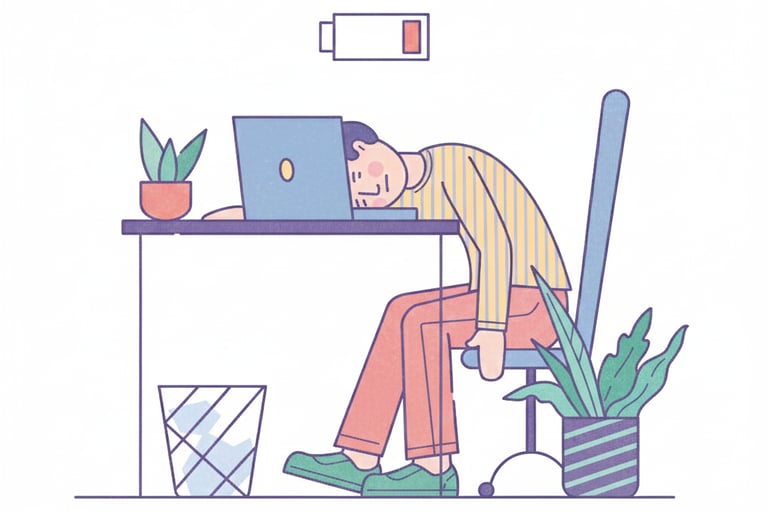
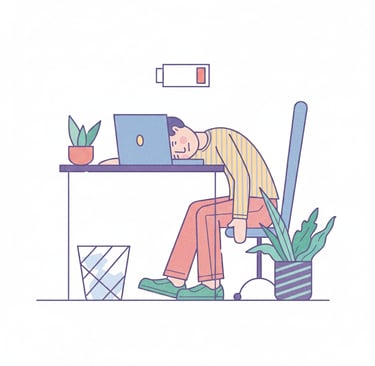
Image from Unsplash
The Modern Problems
Let’s be honest, our childhood dreams of becoming astronauts weren’t destiny, they were infatuations born the moment we read about Neil Armstrong or listened to Space Oddity on loop and thought floating in space looked like a viable career path. And yet, whatever we’ve all ended up doing, this thing we now call work, it isn’t entirely terrible. It pays the bills. I know far too much about wines from all over the world, and I’d already watched two of my top ten music artists perform live by the time I turned 28. So what, exactly, am I complaining about? Something lingers. A phantom at the edge of our vision: not loud enough to name at first, but persistent enough to dull joy.
So let’s address the elephant in the room: BURNOUT.
Humans have always felt overwhelmed, exhausted, stretched thin. But the texture of burnout today is different. The real question is not just “Why are we burned out?” but also “Why did our natural ability to recover got lost?”
In 2024, Mental Health UK warned that a “worrying” number of people taking time off work due to poor mental health could leave the country a “burnt-out nation.” As an Indian millennial, I find this mildly adorable. Not the burnout—the leave. I don’t have a “mental health day” on my HR portal. I have Casual Leave, Sick Leave, and a vague emotional understanding that one must simply carry on. Mental health leave is so unheard and embarrassing. Not to mention, I also lack the cultural confidence to message my team and say, “Hey, I won’t be chiming in with a chirpy ‘Good morning, Karen’ this Monday because I had a dramatic emotional crash-out at 3:00 a.m., re-evaluated my life, cried a little, stared at the ceiling, and spiritually resigned.” Instead, I log in. Camera on. Voice steady. Trauma muted.
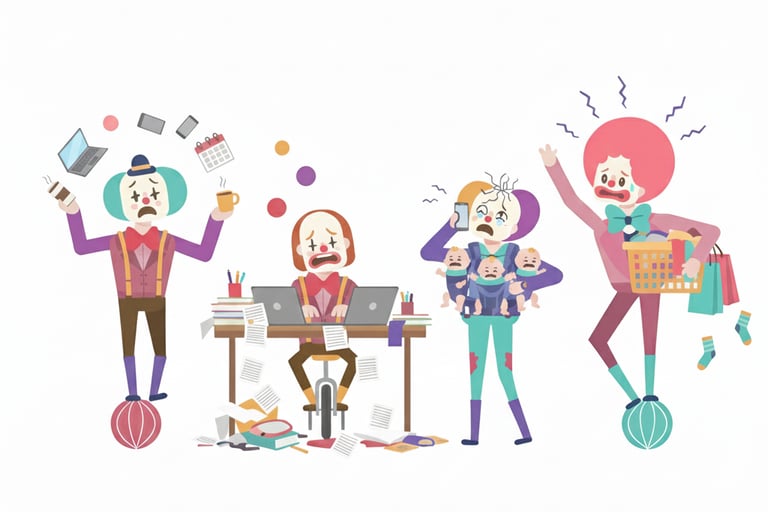
Today’s burnout isn’t like one egg burning quietly in a pan. It’s like two eggs burning, the toast catching fire, marinara splattering everywhere, and the coffee mug flooding the counter, all while you’re trying to reply to a slack message. Burnout today is 3 Cs : Complex, Chronic and Continuous. It is the job itself: the always-on digital availability, blurring the lines of work and personal post pandemic years, the over-optimisation sponsored by none other than the “hustle culture”, job insecurity, a bad manager who themselves circle back to a big bad manager, and it goes on.
Millennials and Gen Z were the first generation who entered adulthood during unstable eras : recessions, layoffs, inflated living costs, housing crises, pandemic, competitive job markets. Us millennials, especially, watched this unfurl, unravel and unsettle right in front of our eyes; it was the overall degradation of the quality of life we once knew and grew up in. Do you remember 9 am cartoon shows and slow evenings? Holding hands and running in the streets because the school bus is here. Exchanging books. Bigger families. Cousins we actually liked and spent time with. Eating out was a rare, celebratory event. A mother’s cooking—an unrecognised string to health and heart. Downloading MP3s. Our first English song. Our first phone, and then the first one with a touch screen—almost deviously designed to become an extension of our bodies: inseparable, intoxicating.
All of this has been replaced by commute and chores, urban stress, noise, pollution, speed, isolation. Fewer real-life relationships. A comparison culture where everyone online appears happier, fitter, richer, more successful. Living costs so high that rest itself feels expensive. Sleep that’s low in quality, food that’s over-processed, routines that are irregular, a decline in foundational spiritual and grounding practices. Little access to nature; and it feels like a punishment.
What’s hilarious is that to compensate for all of the above, we were introduced to a world of hyper-connectivity at $.0.99. We became the first generation to be fully online, the hollow promise of holding on to real connections but all it really is, is data overload. 24/7 stimulation which is ironically numbing. Multitasking and it’s sister, Miss Brain Fog. And the damned doomscrolling masking itself as “nighttime pretend wind-down”. And as if that weren’t enough, we also wandered into the maze of self-optimisation as though we’re prototypes for a new robo-people planet. We’re expected to build a career, run a side hustle, stay fit, eat clean, marry right, be great partners, buy a house, maintain a social life, invest wisely, save consistently, look good, travel, be emotionally intelligent and politically aware—preferably before 30, but we’ll accept 35 if you apologise nicely. Never before has a generation carried this much pressure to optimise every corner of its existence.
I’m not encouraging moral collapse or glorifying mediocrity. I strive to be better everyday. But no matter how hard we try, a human can never be perfect and maybe that is the point. My imperfections are like the mole on my chin. I don’t want to get rid of it. It’s a bookmark on the map of my face. The same face my friends, my family and my husband know, love and adore.
The real issue isn’t only the job—it’s the work culture that convinces us to forget everything that makes being human worthwhile. It is distracting us from remembering to appreciate the art of pleasure, exploring art, passions, quirky interests, being a nerd about something in particular, something utterly obscure and “unproductive”, trying a million hobbies just because we can, the overall human experience. Capitalism tricked us into believing that the only valid way to exist was to hustle until the wheels fall off. To make it in life. But what puts food on the table isn’t supposed to be done from a place of resentment. Work was meant to be just one part of the human experience, not the entire scaffolding of our identity.
A Reminder to the Generation Of Firsts
Sometimes I sit by the window and do nothing (because it is important that we just by the window and do nothing)—the streets are impossibly busy, but I sit in my nineteenth-floor Mumbai apartment, and I stare at the ten-thousand-odd windows scattered across high-rises. I let my imagination wander. In one window, someone smokes a cigarette; in another, the warm glow of a home gym. An unlived home stands waiting, echoing with the sound of workers fitting its interiors. A young woman bends over her laptop. A group of children play on a balcony. The shadows of 4 girls hanging out in the living room. A mother hovers over a gas stove in her kitchen—the slices of life unfolds like a secret orchestra from the 1930s. I draw this contrast with my mom again: was she proud of the life she has had? Wouldn’t she have wanted more? Maybe I am everything she wanted to be 20 years ago.
I bet we are the first generation of women in our families who are independent in the truest, most literal sense of the word. We have autonomy, not the ornamental kind, but actual agency over our money, our bodies, our careers, our movements, our choices. We are the first eldest daughters who can run an entire household without being anyone’s shadow or stand-in. We are the first to sit in boardrooms. We are the first women in our lineages to swipe our own credit cards, to sign rent agreements, to negotiate salaries. The first to live alone in a city without causing a family-wide panic attack. The first to learn self-defence not because the world told us to, but because we wanted to be strong in every sense. The first to take ourselves out to dinner, to buy gold with our money, to plan our future.
We are also the first generation of men who looked at decades of macho conditioning and said, "...No, thanks." The first to choose fashion, or dance, or culinary arts, or photography as a profession without hiding behind the phrase just a hobby. The first sons who proudly became stay-at-home dads. The first to go to therapy and talk about it openly. The first to tell their parents that emotional intelligence isn’t a foreign concept.
We’re the first generation where families have their first female pilots, the first male nurses, the first women who ride superbikes, the first men teaching kindergarten, the first girls who became professional gamers, the first boys who said I don’t want to join the family business; I want to write.
We’re the first Indians in our family trees to backpack across Europe alone, the first to study abroad without marrying someone for a visa, the first to live with roommates from entirely different cultures, the first to take solo trips to the mountains just to clear our heads. The first to say I don’t want children and actually be heard. The first to say No. And mean it.
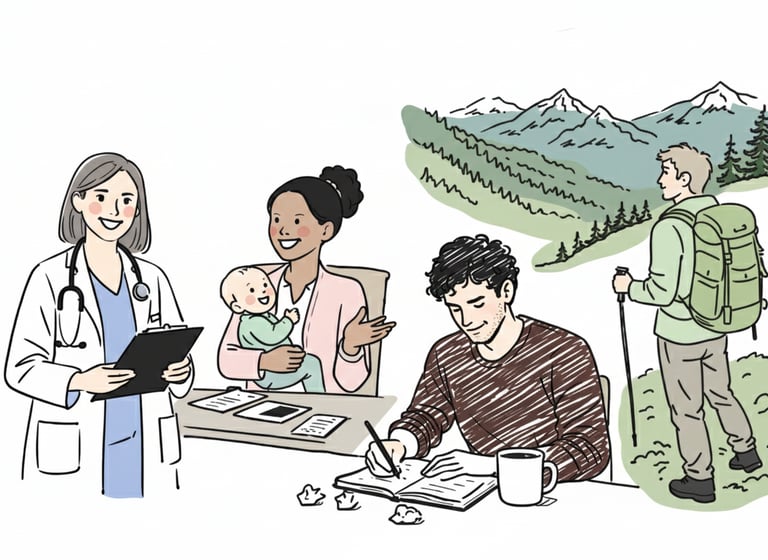
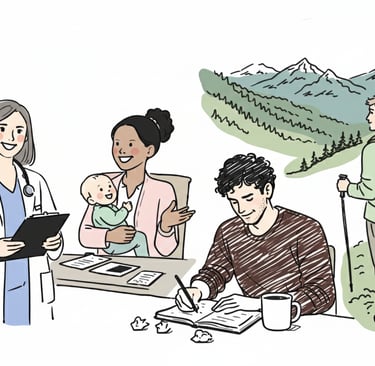
Image generated using AI
Such a colourful array of stories, possibilities, and personal revolutions—and yet we remain so deeply upset. We seem to find “problems” faster than gratitude. Maybe this sounds irrelevant, but stay with me: so much of our attention is consumed by social media, news cycles, and a constant diet of catastrophe. There are a thousand things wrong with the world and a thousand news channels, but not a single one broadcasting the sigh of relief our mothers take at night as they go to bed—feeling proud of their daughters and sons who are returning home, locking the doors of their newly furnished apartments, or cooking dinner in a 1 RK studio in a metro city 500 miles away; happy that they are surviving out there, thriving even, with finesse.
An Ode to My Mother
When my mother visited me for the first time in my first apartment away from home, she walked through it like she was reading a storybook. A well-sized space—not extravagant, but thoughtful. The decent pieces of furniture placed with intention. The warm light pooling into corners. A wall crowded with memories, small souvenirs from places I’ve been. A kitchen fully stocked—the kind that tells you its owner has learned how to feed herself, how to return home at the end of a long day and stay standing.
When I served her dinner—Veg Chow Mein and Manchurian, because Chinese is her favourite—and watched her eat with the unguarded joy of a giddy eight-year-old, I wanted to be my mother’s mother in another lifetime. But she wanted to be my mother all over again. That’s how happy she was. If this isn’t a good life, I don’t know what is.
Image from Freepik
It must be sufficiently stressed that my life and my mother’s are two sides of the same coin. She ran so I could walk. Throughout my childhood, I watched her be strong, stoic, and kind. And for as long as I can remember—until the very last alley of perceivable memory of the little girl I once was—my first instinct in response, which later morphed into a natural habit, was to be strong, stoic, and kind. For her. For years, I tried to recollect the first time I decided to be these things, until I understood there was no single moment. It was inheritance. It was love. And so, in the words of the sweetest, Jeff Buckley, my mother taught me how to dance- full-bodied, starry-eyed, audacious, supernatural, and glorified.
That, I think, is the biggest triumph of our generation. Not perfection. Not optimisation. Just learning how to dance anyway.
Image from Freepik