Uncle Okra, Grandma Karela and the Rest of the Cast: Who Is On Today's Menu?
Written from the heart of a true foodie with too much on her plate — literally and otherwise — this is an urban Indian millennial's honest reflection on the never-ending task of the daily menu.
MILLENNIALSMODERN SOCIETYHUMOURFOOD
3/22/20268 min read

My post content
As a millennial wife in an urban, modern marriage — with an equally urban, modern household in a metropolitan city — it is insane how much creativity can ooze from within me as to how many different things I can do with Indian vegetables: the likes of our reliable uncle Mr. Okra, the grumpy-but-good-willed grandma Bitter Gourd, the sweet-but-perpetually-bullied cousin Lauki, the beauty-with-no-brains middle child Cauliflower, and so on. These are not just vegetables. These are characters. They have arcs. They have opinions. And every single morning, I am the reluctant casting director deciding who gets the lead role in today's lunch and dinner.
Three times a day. Every single day. Three hundred and sixty-five days a year. The menu — what to eat, what feels right, what is healthy, what will be approved by the toughest jury of two people I know: myself and my husband. The sheer mental load of this task is criminally underdiscussed. No one told me that deciding what to eat would become a near full-time cognitive occupation. Nutritionists talk about eating the rainbow; nobody talks about the exhausting creativity it takes to assemble the rainbow daily, with Indian vegetables, on a weekday, after a long work call, for two adults with wildly different palates.
Image: Unsplash


Image: Unsplash
To be clear — I don't even do the cooking. I have hired someone to do it for us, because I was only going to be a liability to my own finances had I not. The food delivery apps were not going to get any more of my money — not if I could help it. Those chaos merchants are already doing enough damage: to health, to lifestyle, to the collective waistline of the urban Indian millennial. And now they want to deliver by drones, apparently. No sir. I have a cook, and I would like that arrangement to work seamlessly. Except it doesn't, because every morning and every evening, he arrives and looks at me with the patient, expectant eyes of a man who has all the culinary skill in the world and absolutely zero desire to apply independent thought to it. "Didi, aaj kya banana hai?" And there it is. The question. Again.
The equation gets more complex because my husband is a picky eater. A specific kind of picky. He doesn't eat green beans. He doesn't eat pointed gourd. He doesn't eat brinjal. Which happen to be, by some cruel cosmic joke, three of my absolute favourites. So now I have a smaller universe of vegetables to work with and the rest of my life stretching ahead of me, asking: what are we eating today?
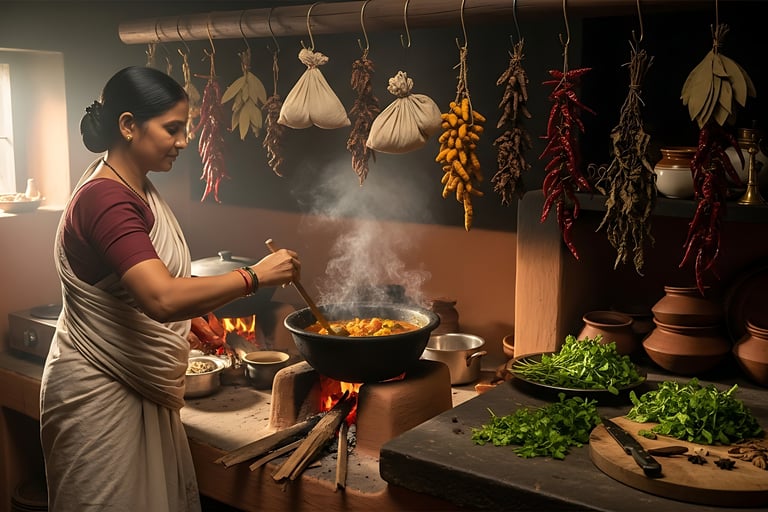
Image: Vecteezy
It is in this pressure cooker (pun very much intended) that I have developed a newfound, almost reverential appreciation for my mother's approach to the daily menu — which was, brilliantly, to not be creative at all. Monday was this. Tuesday was that. Predictable, reliable, non-negotiable. Less thinking, more cooking. She wasn't being lazy. She was being efficient. She was preserving her cognitive bandwidth for things that actually mattered. I understand now, Maa. I understand everything.
But when you don't cook, your subconscious — guilty, restless, overachieving — wants to contribute somewhere. So mine has taken up residence in menu planning with alarming enthusiasm. It wants macros. It wants mood alignment. It wants something that fits the appetite and palate of two very different people, made from whatever is currently surviving in the refrigerator. And in that process, I have ended up discovering and re-learning some genuinely interesting things one can dare to do with Indian vegetables.
Did you know that the stem of a banana plant is entirely edible, and that when cooked with everyday household spices it makes an absolute banger of a curry? Odisha and Bengal have known this forever. The catch is that you must first sit down and meticulously de-thread every single fibrous strand running through it — a meditative, slightly maddening process that is less cooking and more botanical quest. Did you know that the peel of a ripe mango — the part you have been casually discarding your entire life — can be cooked into a curry that is tangy, complex, and quiet magnificent? Did you know that a cucumber, that mild-mannered, universally relegated-to-salad vegetable, can hold its own as a main curry dish at lunch and ask no questions about it? Did you know that cauliflower, that beauty-with-no-brains middle child we met earlier, can be cut into thick steaks, seared, and made to feel genuinely important? That raw, unripe jackfruit — kathal — pulled apart and spiced up, is such a convincing main dish that it has successfully fooled many a unsuspecting lunch guest? And that the flowers of a pumpkin plant — those delicate, golden, fleeting things — can be battered and fried into fritters that taste like a summer afternoon decided to become food? This is the genius of the Indian kitchen. It looks at every part of every plant and asks not can we eat this but how extraordinarily can we eat this.
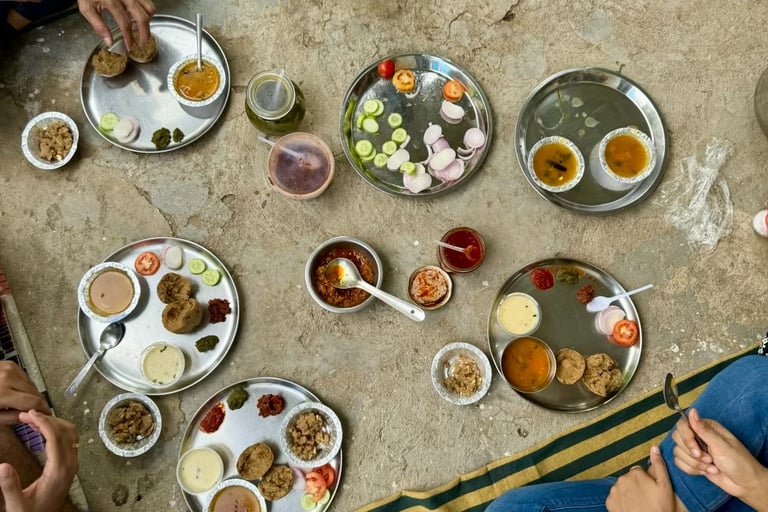
Image by Author: A Rajasthani Dal Bati Churma Spread
Did you know you can make a completely convincing pasta sauce base with raw tomatoes, a generous hand of garlic, and dried red chillies — and that it tastes like it has a Roman grandmother behind it? Did you know that if you roll atta thin enough, cut it right, and toss it in said sauce with gavar phali (cluster beans, for the uninitiated), you get something that is technically an Indianised pasta and completely, absolutely delicious — one of the many wondrous dishes that my Rajasthani in-laws showed me. The glorious Dal Bati Churma is just the tip of a delicious iceberg. My Odia origin is forever staggered by what Rajasthan does with its food. Two-plus years of marriage into the culture and I am shook by the way they handle dals, pulses, cereals — the layering, the tempering, the sheer audacity of the flavour combinations — it is the stuff of culinary dreams.
But for all my wide-eyed wonder at what Rajasthan does with its pantry, there is a stubborn corner of me that will always belong to Odisha. And nowhere does that corner assert itself more loudly than when I think about pakhala bhata. If you are not Odia, I am not sure I can fully explain it to you in a way that does it justice, but I will try. Pakhala Bhata is cooked rice soaked overnight in water — fermented gently by morning into something cool and slightly tangy. It is served cold with yogurt, salt, ginger, raw onions, slit green chillies and a wedge of lemon. And what it is served with is where the real poetry begins. On a proper pakhala spread, you will find bhaja — things that have been fried to crisp, golden perfection: aloo (potato) bhaja, baigana (brinjal) bhaja, kalara (bitter gourd) bhaja, potala (pointed gourd) bhaja, saga (green leafy vegetables) bhaja. You will find chakata — the mashed things, humble and extraordinary — aloo (potato) chakata with its sharp hit of mustard oil and raw onion, baigana (brinjal) poda with its smoky roasted soul, tomato poda that tastes like it has been kissed by fire, you can do the same roasting and mashing with pointed gourd and snake gourd too (my personal favourites). There will be badi chura, those crushed fried lentil dumplings punched together with ground roasted peanuts and garlic to add a touch of texture and a whole lot of fun. This is not a meal. This is a composition. And growing up, it was the food we ate on sweltering Odia summer afternoons when the heat was a physical, oppressive presence and the ceiling fan was doing its sincere best and failing. A cold bowl of pakhala bhata with this entire universe around it was not just lunch it was a recalibration and a celebration of food. The Odia kitchen has always known something the rest of the culinary world is only now catching up to — that fermented food is sacred, that simplicity is not laziness, and that sometimes the most radical thing you can put on a table is cold rice soaked in water, surrounded by twelve little bowls of love, and mean it with your whole chest.
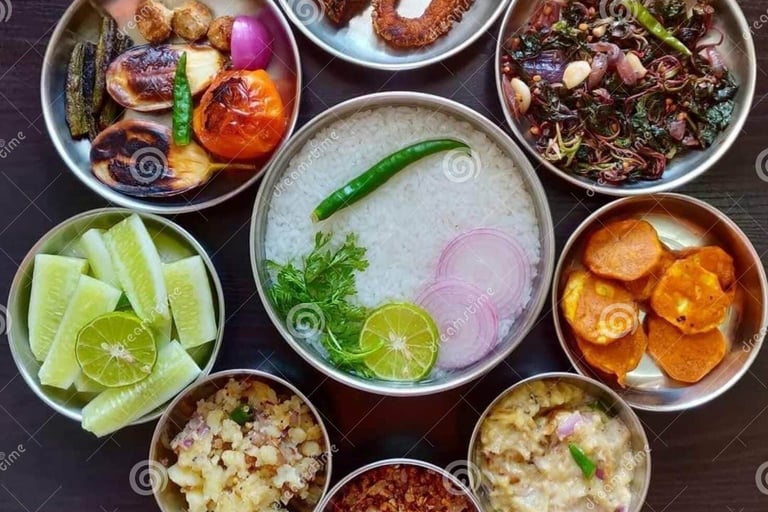
Image: Dreamstime
And then there is Maharashtra, which has been home for almost a decade now. Pav bhaji on tired Fridays. Thetcha — that fiercely pounded green chilli and garlic chutney, rough-textured and unrepentant, the kind of condiment that just boldly shows up on hungrier days. Rawa fries. Malvani curries with their deep coconut bases and coastal confidence. These have permanently entered our menu rotation and I wouldn't have it any other way. My kitchen is not the straightforward Odia kitchen my mother ran. When she visited and opened my refrigerator, she stood there for a moment, quietly scanning its contents — realising it was not just a fridge, but a cold archive of several cultures.
But then — then — there is the other universe. The exotic additions. Don’t even get me started when these exotic varieties get added into the mix. Cauliflower, post her semester abroad in London, is technically the same vegetable but insists on being roasted whole with za'atar now— Broccoli moved in and never left, mostly because it photographs well and pretends to be a tree, which delights me every time. The bell peppers — that business school duo, the yellow and red twins who studied abroad on a part-time program and came back thinking they were a different species than our household capsicum— they are fine, genuinely fine, but require more effort than they let on. The asparagus is beautiful and I want to like her more than I do. And then there is the purple cabbage: the one who went to beauty school, got her hair coloured, she thinks she is better than everybody, but all she can be is a salad.
What nobody told us — the millennials, standing at the exact intersection of the 90s Indian kitchen and the 2020s explosion of exposure to global cuisines — is that incorporating these vegetables into a practical, daily menu requires a whole separate education. They taste fantastic. They look extraordinary. But they were never part of how we grew up eating. Nobody taught us how to store asparagus or what to actually do with a head of purple cabbage on a Tuesday night. It is startling, really, how much capacity we harbour for change — how we adapted to a world that became entirely unrecognizable from the one we grew up in. Therefore, we were never taught how to handle a kitchen, an inventory, a menu for an audience that seeks the comfort of a moong dal khichdi and also tends to have new age cravings like mushroom rice paper dumplings, for fucks sake. We want it all. We were surgically placed in the middle of two worlds with zero remorse.


Image: Unsplash
The colours of Indian vegetables may be one too many to drive an Indian millennial working wife to the edge — and some days, they absolutely do — but at the end of the day, on most days, it is the most fun she had. The private satisfaction of putting together a perfect menu from whatever the fridge and the universe offered. If I did nothing else worth mentioning today, I devised a smart, considered menu that lifted the spirits of two tired people after a long day at work. And that, I have decided, counts for more than most things.
If you are currently reading this and feeling sympathetic: please don't. It doesn't look good on you. Gift me an air-fryer instead.